

San Diego is widely recognized as one of the most desirable coastal living destinations in the United States. According to recent demographic data, the region has seen consistent population growth, driven by its mild climate and robust economy. This demand creates a highly competitive real estate market where timing and strategy are everything. Whether you are relocating from out of state or upgrading within the county, understanding the local nuances is critical to securing your dream property. This guide outlines the essential phases of the home-buying journey, tailored specifically for the San Diego landscape.
Phase 1: Financial Preparation and Mortgage Pre-Approval
Before you begin touring homes, you must establish a clear financial foundation. Purchasing a property is often the largest financial decision an individual makes. In a market like San Diego, where median home prices frequently exceed national averages, lenders scrutinize financial health closely.
Understanding Your Budget
Start by calculating your debt-to-income ratio and determining how much you can comfortably allocate toward a monthly mortgage payment. It is not enough to know what you can afford based on the loan amount. You must also account for property taxes, homeowners insurance, and potential Homeowners Association (HOA) fees, which are common in many San Diego communities.
Securing Pre-Approval
A mortgage pre-approval letter is your ticket to serious consideration in a competitive market. Unlike pre-qualification, which is a rough estimate, pre-approval involves a thorough verification of your income, assets, and credit history. Sellers in San Diego often reject offers from buyers without this documentation because it signals financial reliability. Without pre-approval, you risk falling in love with a home only to find out you cannot secure the financing.
Phase 2: Analyzing San Diego Neighborhoods and Communities
San Diego is not a monolith. It is a collection of distinct communities, each with its own character, price point, and lifestyle appeal. Understanding these differences is vital to narrowing your search effectively.
Coastal vs. Inland Dynamics
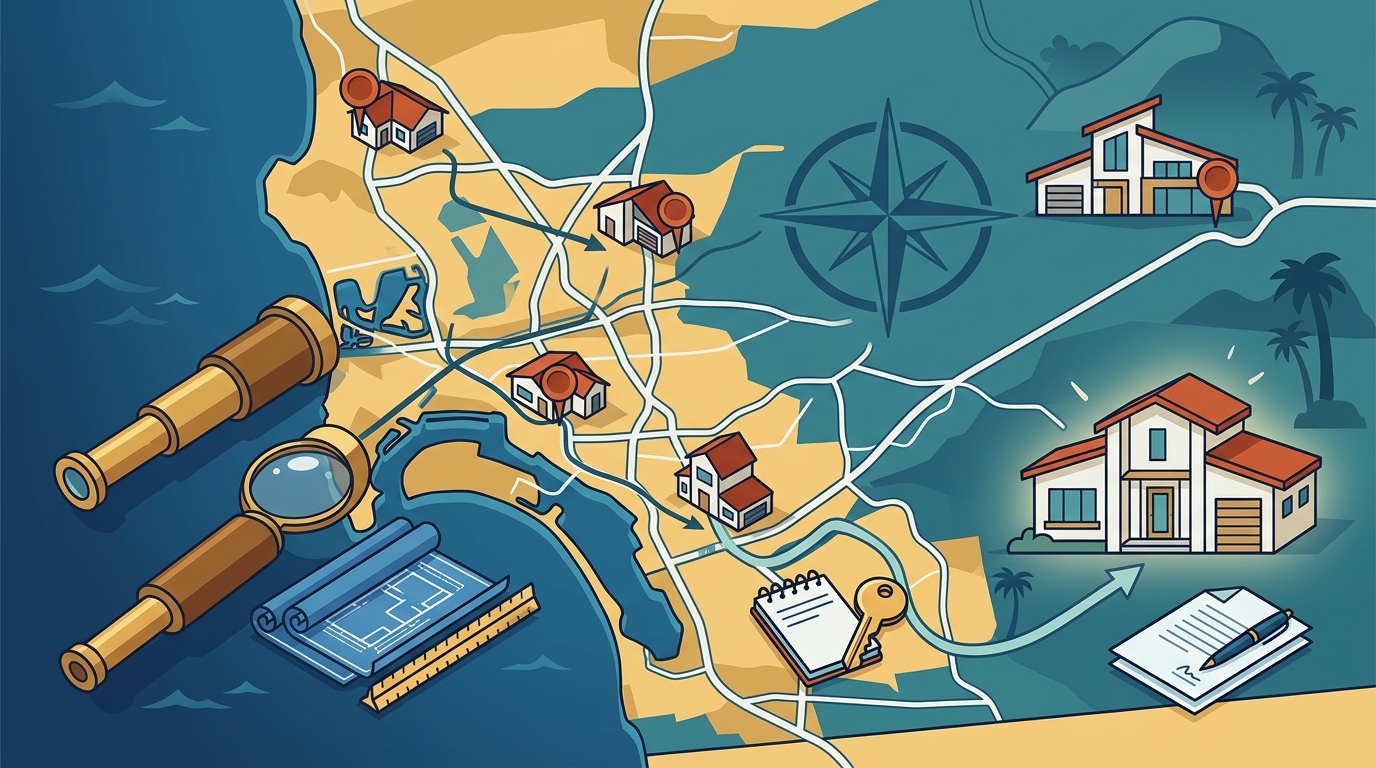
The coastal corridor, including areas like Encinitas, Cardiff by the Sea, and Solana Beach, offers direct beach access and a relaxed, surf-centric culture. These areas command premium prices due to their scarcity and desirability. In contrast, inland communities like Carlsbad and San Marcos offer more square footage for the money and are often preferred by families seeking larger yards and top-rated school districts.
Lifestyle Considerations
Define what matters most to you. Do you need walkable urban amenities, or do you prefer the quiet of Rancho Santa Fe? Are you looking for a historic bungalow in La Jolla or a modern new construction in Oceanside? Each neighborhood has unique zoning laws, architectural styles, and community vibes. Researching these details early prevents wasted time on properties that do not align with your long-term lifestyle goals.
Phase 3: Selecting a Strategic Real Estate Advisor
In a complex market, having a knowledgeable guide is indispensable. A skilled real estate agent does more than show houses. They provide market intelligence, negotiate on your behalf, and manage the intricate logistics of the transaction.
Why Local Expertise Matters
San Diego's real estate landscape is influenced by geographic constraints, such as coastal development restrictions, and economic factors, including the presence of major tech and military employers. An agent who specializes in this region understands the subtle shifts in inventory levels and buyer demand. For instance, knowing when a specific neighborhood is about to see a surge in new listings can give you a critical head start.
Evaluating Agent Credentials
Look for agents with a proven track record in your target price range and neighborhood. Check their recent sales history and client testimonials. A good agent will ask you detailed questions about your needs and will not hesitate to tell you if a property is a poor fit. They should be transparent about their communication style and availability. The Davis Group, for example, emphasizes integrity and clear communication, helping clients navigate every step of the buying process with confidence.
Phase 4: The Property Search and Viewing Process
Once you have your finances in order and a clear list of desired neighborhoods, the active search begins. In San Diego, inventory can move quickly, especially in the spring and summer months.
Utilizing Technology and Networks
Start with online listing platforms to get a feel for current prices and available features. However, do not rely solely on public data. Your agent can provide access to off-market listings or properties that are about to hit the market. This "pocket listing" advantage is often the key to finding hidden gems before they are seen by the general public.
Conducting Effective Viewings
When you tour a home, look beyond the staging. Pay attention to the structural integrity, the condition of the roof and HVAC systems, and the natural light. In coastal areas, check for signs of salt air corrosion or moisture intrusion. In inland valleys, consider the quality of the insulation and cooling capacity. Take notes and photos during each viewing to help you compare properties objectively later.
Phase 5: Making Offers and Negotiating Terms
Finding the right home is only half the battle. Securing it requires a well-crafted offer and skilled negotiation. San Diego's market can swing between a buyer's and seller's market depending on interest rates and inventory levels.
Structuring Your Offer
Your offer price should be based on a comparative market analysis (CMA) of similar recently sold homes in the area. In a hot market, you may need to offer above asking price. In a cooler market, there may be room for negotiation. Consider including contingencies that protect you, such as financing and inspection clauses, but be prepared to waive some in highly competitive situations to make your offer more attractive.
Negotiation Strategies
Your agent will help you determine the best negotiation strategy. This might involve asking for repairs, requesting a closing cost credit, or adjusting the closing date to suit the seller's needs. Understanding the seller's motivation is crucial. Are they downsizing? Relocating for a job? Their urgency can provide leverage in negotiations.
Phase 6: Inspections, Appraisals, and Closing
Once your offer is accepted, you enter the escrow period. This is when the due diligence phase occurs. You will hire professionals to inspect the property and the lender will order an appraisal to ensure the home's value matches the loan amount.
The Importance of Inspections
Never skip the home inspection. Even new construction can have defects. A thorough inspection can reveal hidden issues with plumbing, electrical systems, or foundation stability. If significant problems are found, you can negotiate repairs or a price reduction, or in severe cases, walk away from the deal.
Finalizing the Purchase
Before closing, review all closing documents carefully. Ensure that the title is clear and that all agreed-upon repairs have been completed. On closing day, you will sign the final paperwork and transfer the funds. Once recorded, you officially become the owner of your new San Diego home.
Summary of Key Steps
| Phase | Key Action | Outcome |
|---|---|---|
| Financial Prep | Secure Mortgage Pre-Approval | Established buying power and credibility |
| Market Analysis | Research Neighborhoods | Defined target areas and lifestyle fit |
| Agent Selection | Hire Local Expert | Access to off-market and strategic insights |
| Property Search | Tour and Evaluate Homes | Shortlist of viable properties |
| Offer & Negotiation | Submit Competitive Offer | Accepted contract with favorable terms |
| Closing | Complete Inspections & Appraisal | Secure transfer of ownership |
Key Takeaways
- Financial Readiness: Secure a mortgage pre-approval before starting your search to demonstrate seriousness to sellers.
- Neighborhood Specificity: San Diego's diverse communities require careful selection based on lifestyle, not just price.
- Local Expertise: Work with an agent who understands the nuances of the San Diego market, such as coastal restrictions and inventory trends.
- Due Diligence: Never waive inspections in a market where you have the leverage to do so. Protect your investment.
- Strategic Offers: Structure your offer based on data, not emotion. Use your agent to negotiate terms that benefit you.
- Long-Term Vision: Consider resale value and community growth potential when making your final decision.
- Professional Support: The Davis Group provides comprehensive support for buyers, ensuring a seamless experience from search to closing.
Frequently Asked Questions
How long does the home-buying process take in San Diego?
The timeline varies based on market conditions. On average, the process from pre-approval to closing takes 30 to 45 days. However, the search phase can last several months if inventory is low or if you have very specific criteria.
What is the average down payment for a home in San Diego?
While there is no single average, many buyers put down between 5% and 20%. First-time homebuyer programs may allow for lower down payments, but private mortgage insurance (PMI) may be required if you put less than 20% down.
Why is it important to work with a local real estate agent?
Local agents have access to off-market listings and understand neighborhood-specific trends, such as flood zones, school district boundaries, and future development plans that can impact property values.
What are the most popular neighborhoods for families in San Diego?
Areas like Carlsbad, San Marcos, and parts of Rancho Santa Fe are highly sought after by families due to their top-rated schools, parks, and community-oriented lifestyles.
How do I handle a bidding war in San Diego?
Work with your agent to write a strong, clean offer. This may include a larger earnest money deposit, flexible closing dates, or waiving certain contingencies if you are comfortable with the risk.
What should I look for during a home inspection?
Focus on structural integrity, roof condition, plumbing, electrical systems, and HVAC. In coastal areas, check for salt damage and moisture issues. In inland areas, look for signs of pest damage or foundation settling.
Can I buy a home in San Diego without visiting in person?
While possible, it is not recommended. Virtual tours can help narrow down options, but seeing the property in person is crucial for assessing light, noise, and neighborhood feel.
Ready to Find Your Dream Home?
Finding your ideal home in San Diego requires a blend of financial preparation, market knowledge, and expert guidance. The Davis Group is here to help you navigate every step of this journey. With decades of experience and a deep understanding of the local market, we are committed to helping you make informed decisions and achieve your real estate goals. Contact us today to schedule a consultation and begin your search for the perfect home.